Financial Impact: €100M Release Clause Trend Shaping 2026 Squads
Advertisements

The proliferation of 100 million euro release clauses is profoundly altering European football’s financial landscape, dictating transfer market dynamics and shaping squad compositions for the 2026 season.
In the high-stakes world of European football, the phrase €100 Million Release Clause has become a frequent headline, signaling a tectonic shift in player valuations and transfer market strategies. This trend isn’t just about astronomical figures; it’s fundamentally reshaping how clubs build their rosters, influencing everything from youth development to financial planning for the 2026 season and beyond. Let’s delve into the intricate financial web woven by these clauses.
The Genesis of the €100 Million Release Clause Phenomenon
The concept of a release clause, while long-standing in some European leagues, has seen its valuation spiral upwards dramatically in recent years. What was once a rare occurrence for only the truly elite has now become a standard, almost expected, figure for promising talents and established stars alike. This evolution is not coincidental but a direct response to various market pressures and strategic maneuvers by clubs.
Initially, release clauses served as a safety net for players, offering a clear path to exit if a club met a predetermined price. For clubs, it provided a benchmark for valuing their most prized assets. However, as transfer fees began to inflate, particularly after landmark deals, the perceived value of top-tier talent skyrocketed. Clubs started setting increasingly higher clauses to deter unwanted approaches or to ensure a substantial payout should a star depart.
Historical Context and Market Shifts
Understanding where these figures originate requires a look back at pivotal transfers that reset the market. Neymar’s move to PSG for €222 million in 2017 is often cited as the catalyst, demonstrating that seemingly insurmountable clauses could indeed be met. This single transfer recalibrated expectations across the continent, prompting clubs to re-evaluate their own players’ market worth and adjust clauses accordingly.
- Neymar’s PSG Transfer: A watershed moment that proved the feasibility of activating colossal release clauses.
- Financial Fair Play (FFP) Regulations: While intended to curb excessive spending, FFP sometimes inadvertently encourages clubs to demand higher fees to balance their books.
- Increased Broadcasting Revenues: A surging influx of money into football has empowered clubs, particularly those in top leagues, to spend more freely.
- Player Power: Agents and players increasingly demand higher clauses as a guarantee of future mobility or a better contract.
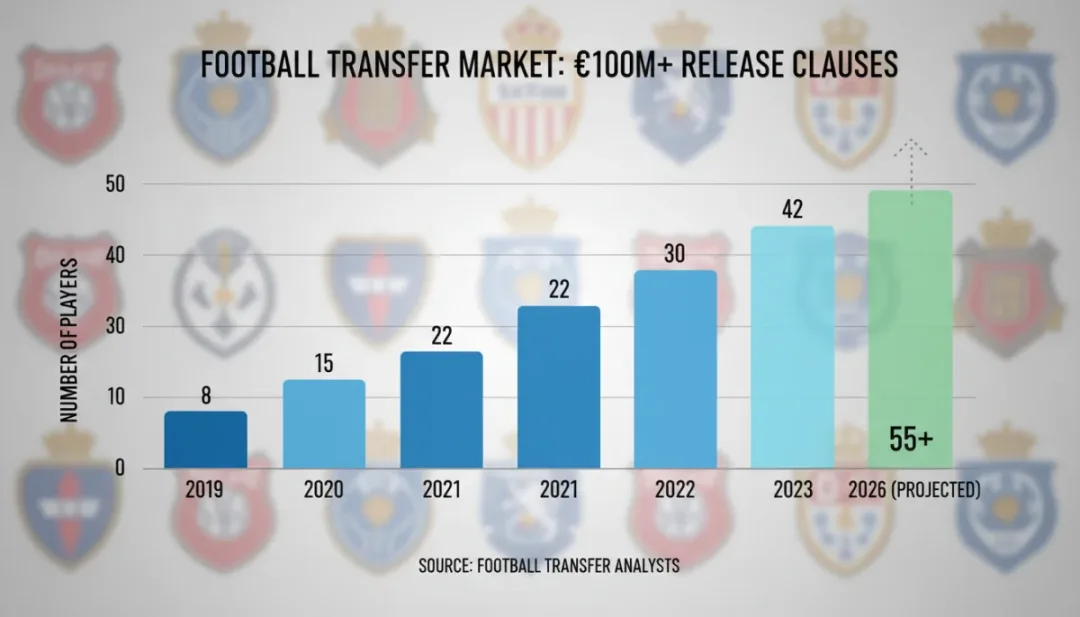
The trend shows no signs of slowing, with an increasing number of players, even those not yet at their peak, being valued at or above this threshold. This makes the negotiation landscape a complex one, where clubs must balance financial prudence with the ambition to retain or acquire generational talent.
Impact on Club Transfer Strategies and Player Valuations
The pervasive nature of the €100 million release clause profoundly alters how clubs approach the transfer market. It introduces both a ceiling and a floor to negotiations, often simplifying the process for buyers willing to pay the full amount, but also complicating it for clubs hoping to negotiate a lower fee. For selling clubs, it’s a double-edged sword: a guarantee of a significant sum, but also the potential loss of a key player without the option to negotiate for more or to retain them.
Player valuations are no longer solely based on performance or potential; the presence and amount of a release clause heavily influence their perceived market worth. A player with a €100 million clause is immediately deemed a ‘€100 million player,’ regardless of whether a club would pay that in open negotiation. This creates a psychological benchmark that permeates discussions and media narratives.
Strategic Implications for Buying Clubs
For clubs with deep pockets, meeting a €100 million release clause can be a straightforward way to secure a target, bypassing lengthy negotiations. This can be particularly appealing when dealing with clubs that are reluctant to sell. However, it also means committing a substantial portion of their transfer budget to a single player, potentially limiting other acquisitions.
- Direct Acquisition: Bypassing negotiation saves time and effort, especially for highly sought-after players.
- Budget Allocation: A single large transfer can significantly impact overall squad building funds.
- Risk Assessment: Paying such a high fee demands absolute certainty about the player’s fit and performance.
Conversely, clubs with more modest budgets find themselves increasingly priced out of the market for these ‘€100 million’ talents, forced to look for undervalued players or develop their own. This widens the gap between the financial elite and the rest, potentially impacting competitive balance in the long run.
The Player’s Perspective: Agents, Contracts, and Career Paths
For players and their agents, the €100 million release clause is a powerful tool in contract negotiations. It offers a clear pathway for a potential move, either to a bigger club or simply to a new challenge, without being entirely at the mercy of their current club’s whims. This leverage can also translate into higher wages and better personal terms, as clubs know they must offer an attractive package to retain players with such high market value.
Agents actively push for these clauses, seeing them as a means to control a player’s destiny and maximize their earning potential. A high clause signals a player’s perceived value and talent, enhancing their brand and marketability. It can also be a point of pride, placing them among an elite group of footballers.
Negotiation Dynamics and Player Mobility
The presence of a significant release clause fundamentally shifts the power dynamic in contract talks. Clubs often agree to these clauses to secure a player’s commitment, knowing the financial upside if the clause is eventually met. However, it also means they are effectively putting a price tag on their star, making them vulnerable to approaches if a rival club decides to activate it.
- Increased Player Leverage: Clauses provide a pre-agreed exit strategy, empowering players.
- Agent Influence: Agents use clauses to secure better deals and career progression for their clients.
- Career Planning: Players can strategically plan their career moves, knowing the financial threshold for a transfer.
While a high clause can deter some suitors, it also attracts the wealthiest clubs, potentially leading to a player moving to a club that can guarantee Champions League football and higher wages. This dynamic ensures that top talent often congregates in a select few financially powerful clubs, further concentrating footballing excellence.
Financial Fair Play and Sustainability in the Age of Mega-Clauses
Financial Fair Play (FFP) regulations, introduced by UEFA, aim to ensure that clubs spend within their means and avoid excessive debt. However, the rise of the €100 million release clause presents a complex challenge to these regulations. While a club receiving such a sum gets a significant financial boost, the buying club must demonstrate that the expenditure is sustainable and compliant with FFP rules.
The sheer volume of money now flowing through transfers, often facilitated by these clauses, raises questions about the long-term financial health of the sport. Clubs must carefully manage their finances, ensuring that even substantial income from player sales is reinvested wisely and doesn’t lead to a cycle of overspending that could result in FFP breaches.
Balancing Books with Big Bets
The strategy for clubs is to balance the immediate financial injection from a clause activation with the need to replace a key player. This often means reinvesting the funds into multiple players or securing another high-profile talent, creating a ripple effect across the market. The sustainability aspect comes into play when clubs consistently spend more than they earn, even if those earnings include a massive one-off transfer fee.
The trend pushes clubs to be more innovative in their financial models, seeking alternative revenue streams and carefully managing player contracts. It also places a greater emphasis on youth academies, as developing talent internally can provide a cost-effective alternative to expensive market acquisitions, and potentially generate future €100 million sales.
The Shifting Landscape of Squad Building for 2026
As we look towards the 2026 season, the €100 million release clause trend is undeniably shaping squad compositions. Clubs are increasingly focused on identifying and securing young talent with high potential, often embedding significant release clauses into their initial contracts. This proactive approach aims to protect their investments and ensure a substantial return should a player become a global superstar.
The market for established, world-class players is becoming even more exclusive, dominated by a handful of super-rich clubs capable of activating these clauses. This forces other clubs to adopt different strategies, focusing on shrewd scouting, tactical flexibility, and fostering team cohesion over individual star power.
Emerging Trends in Player Recruitment
The emphasis is shifting towards data-driven recruitment, identifying players who can offer similar output to top stars but at a fraction of the cost. Loan deals with options to buy, often with performance-related clauses that could eventually reach the €100 million mark, are also becoming more common as clubs seek to mitigate risk.
- Youth Development Priority: Investing in academies to produce future €100 million players.
- Data-Driven Scouting: Identifying undervalued talent to build competitive squads without breaking the bank.
- Loan-to-Buy Strategies: Mitigating financial risk by testing players before committing to large fees.
This dynamic creates a two-tiered market: one for the elite with the financial muscle to activate mega-clauses, and another for clubs that must innovate and seek value in less obvious places. The result is a more diverse approach to squad building, even if the top end of the market remains highly concentrated.
Future Outlook: Will €100 Million Become the New Normal?
The trajectory of transfer fees and release clauses suggests that the €100 million mark, while still significant, is rapidly becoming a more common benchmark for top-tier talent. As broadcasting revenues continue to grow and global interest in football intensifies, the financial capacity of leading clubs is likely to expand further, enabling them to meet these escalating valuations.
However, there are also discussions about potential regulatory interventions to curb excessive spending and promote greater competitive balance. Whether these materialize and how effective they would be remains to be seen. For now, the trend points towards a future where multi-million-euro deals, particularly those involving release clauses, are an increasingly routine feature of the transfer window.
Potential Challenges and Opportunities
While the financial power of clubs grows, so does the pressure to perform. Investing €100 million in a player carries immense expectations, and failure to deliver can have significant financial and sporting repercussions. This creates an environment of high risk and high reward, where strategic decisions are more critical than ever.
- Inflationary Market: Continued rise in player valuations and transfer fees.
- Regulatory Scrutiny: Potential for new FFP rules or transfer caps to address market inflation.
- Increased Competition: Clubs will continue to vie fiercely for the most promising talents, driving up prices.
The future of European football’s financial landscape will undoubtedly be shaped by these clauses. Clubs that adapt best to this environment, whether by leveraging their financial might or by focusing on smart, sustainable development, will be best positioned for success in 2026 and beyond. The strategic implications are vast, impacting every facet of club operation from the boardroom to the training ground.
| Key Impact Area | Brief Description |
|---|---|
| Transfer Market Dynamics | €100M clauses set price benchmarks, accelerating deals for top clubs and limiting options for others. |
| Player Power & Wages | Players and agents gain leverage, securing higher wages and clear exit paths. |
| Club Financial Strategy | Clubs balance FFP, high spending, and reinvestment from clause activations. |
| Squad Building for 2026 | Focus on youth development, data-driven scouting, and strategic loan deals to compete. |
Frequently Asked Questions About Release Clauses
What is a release clause in football?▼A release clause is a contractual provision allowing a player to unilaterally terminate their contract if a specific, predetermined fee is paid to their club. It effectively sets a minimum transfer price, offering a clear path for a player’s departure.
Why are €100 million release clauses becoming more common?▼They are increasingly common due to inflated transfer fees, increased broadcasting revenues, and the desire of clubs to protect their star assets. The Neymar transfer in 2017 also reset market expectations for elite player valuations.
How do release clauses impact smaller clubs?▼Smaller clubs benefit from significant payouts when a clause is activated, potentially allowing reinvestment. However, they also face the risk of losing key players without further negotiation, making squad planning challenging.
Do release clauses violate Financial Fair Play regulations?▼Not inherently. While activating a large clause represents a significant expenditure, clubs must still comply with FFP by demonstrating financial sustainability. Income from activated clauses helps clubs balance their books.
What does this trend mean for European squads by 2026?▼By 2026, it will likely lead to further concentration of top talent in elite clubs, a greater emphasis on youth development, and more innovative transfer strategies among clubs with smaller budgets, shaping competitive landscapes.
Conclusion
The emergence of the €100 million release clause as a prominent feature of European football transfers signifies a profound transformation in the sport’s financial and strategic landscape. This trend not only dictates player valuations and club spending but also reshapes squad building philosophies, influencing how teams approach the 2026 season and beyond. As clubs navigate this high-stakes environment, the ability to adapt to these financial dynamics will be paramount for sustained success and competitive relevance.