Unpacking Data: Europe’s Most Valuable Strikers 2026 Metrics
Advertisements

This article unpacks the data on how three key performance metrics—Goals per 90, Expected Goals (xG) plus Expected Assists (xA), and Progressive Carries—define Europe’s most valuable strikers for 2026, offering insights into player worth.
In the rapidly evolving landscape of European football, understanding what truly constitutes a valuable striker goes beyond mere goal tallies. To genuinely assess and predict the elite forward talent for 2026, we must look deeper into statistical nuances. This article delves into Unpacking the Data: How 3 Key Performance Metrics Define Europe’s Most Valuable Strikers for 2026, offering a comprehensive look at the analytical bedrock of player valuation.
The Evolution of Striker Valuation in Modern Football
The role of a striker has undergone a significant transformation. Once primarily judged by goals alone, modern football demands a more multifaceted contribution from its frontmen. This evolution necessitates a more sophisticated approach to player valuation, moving beyond traditional statistics to embrace advanced metrics that capture a striker’s overall impact on the game.
Clubs and scouts now utilize sophisticated data models to identify players who not only score but also contribute significantly to build-up play, pressing, and chance creation. This holistic view ensures that investment in a striker is based on a robust understanding of their potential and suitability for a team’s tactical framework. The days of simply counting goals are largely behind us.
Beyond Goal Counts: A Deeper Dive
While goals remain the ultimate currency for any forward, relying solely on them can be misleading. A striker might score many goals from a high volume of low-quality chances, or conversely, score fewer but crucial goals from excellent opportunities. This is where advanced metrics come into play, providing a clearer picture of a player’s genuine attacking prowess.
- Contextualizing Goal Scoring: Examining goals in relation to the quality of chances created helps differentiate between clinical finishers and volume shooters.
- Impact on Team Play: Understanding how a striker’s movement and link-up play create opportunities for teammates is crucial.
- Defensive Contributions: A modern striker’s ability to press and win the ball high up the pitch adds significant value to their team.
The ability to integrate seamlessly into a team’s offensive and defensive schemes elevates a striker’s market value considerably. Data analytics provides the tools to quantify these contributions, offering a competitive edge in player recruitment and development.
In conclusion, the valuation of strikers has matured from a simple tally to a complex analytical process. This shift ensures that clubs are making informed decisions, identifying players who are not just prolific scorers but also integral components of a successful modern football team. The metrics discussed here are vital for discerning true value.
Goals per 90: The Undeniable Foundation of Striker Worth
Goals per 90 (G/90) is perhaps the most fundamental metric for evaluating a striker’s effectiveness. It normalizes goal output across different playing times, providing a clear indication of how frequently a player finds the back of the net when on the pitch. For 2026, this metric remains paramount, serving as the baseline for any serious assessment of a striker’s value.
High G/90 numbers signal a player’s consistent threat in front of goal, a non-negotiable attribute for any top-tier forward. However, it’s crucial to analyze G/90 in conjunction with other data points to understand the full context of a striker’s performance and avoid drawing superficial conclusions.
Consistency and Clinical Finishing
A high G/90 rate often points to a striker’s clinical finishing ability. These are players who can convert a significant percentage of their chances into goals, making every opportunity count. Such efficiency is invaluable, particularly in tight matches where chances are few and far between.
- Shot Conversion Rate: A high G/90 often correlates with an excellent shot conversion rate, indicating a player’s ability to finish under pressure.
- Goal Poaching Instincts: Players with strong G/90 metrics typically possess an innate sense of positioning, allowing them to be in the right place at the right time.
- Versatility in Scoring: The best strikers demonstrate diverse ways of scoring, whether with both feet, headers, or from different ranges.
Consistency in scoring, reflected by a sustained high G/90 over multiple seasons, is a hallmark of truly valuable strikers. It suggests reliability and an enduring capacity to perform at the highest level, making them attractive assets for any club.
While G/90 provides a direct measure of goal-scoring prowess, its interpretation must be nuanced. Factors like team quality, tactical setup, and the number of clear-cut chances created for the striker can all influence this metric. Nonetheless, a strong G/90 remains a foundational indicator of a striker’s worth, proving their primary function is being fulfilled effectively.
Expected Goals (xG) and Expected Assists (xA): Measuring True Offensive Threat
Beyond actual goals, Expected Goals (xG) and Expected Assists (xA) offer a more granular understanding of a striker’s offensive contribution. xG quantifies the probability of a shot resulting in a goal, based on factors like shot location, body part used, and type of assist. xA measures the likelihood that a pass will become a goal assist. Together, these metrics provide insights into a player’s underlying chance creation and finishing quality, irrespective of whether the chances were converted.
For 2026, these metrics are vital for identifying players who consistently get into good scoring positions or create high-quality opportunities for teammates, even if their actual goal/assist tally might fluctuate due to luck or poor finishing from others. They reveal a player’s true offensive threat potential.
Understanding Shot Quality and Chance Creation
xG helps distinguish between a striker who scores many goals from difficult positions and one who consistently gets into high-probability scoring areas. A high xG indicates a player’s ability to generate quality shots. Similarly, a high xA showcases a player’s vision and passing accuracy in setting up teammates for scoring opportunities.
- Predictive Power: xG and xA are strong predictors of future goal and assist output, making them crucial for long-term player valuation.
- Evaluating Decision-Making: These metrics help assess a striker’s decision-making in the final third, highlighting players who consistently make the right choices.
- System Independence: Unlike raw goals or assists, xG and xA are less dependent on the overall quality of the team, offering a more isolated view of a player’s individual contribution.
Players who consistently outperform their xG are often considered exceptional finishers, while those with high xG but lower actual goals might be experiencing a streak of bad luck or need to improve their finishing. Conversely, a high xA suggests a creative force, regardless of whether teammates convert the chances.
In essence, xG and xA move beyond the outcome to evaluate the process. They provide a more stable and reliable measure of a striker’s offensive talent, highlighting players who are consistently creating value, even when the scoreboard doesn’t always reflect it. This makes them indispensable tools for identifying valuable strikers for 2026 and beyond.
Progressive Carries: Driving the Attack Forward
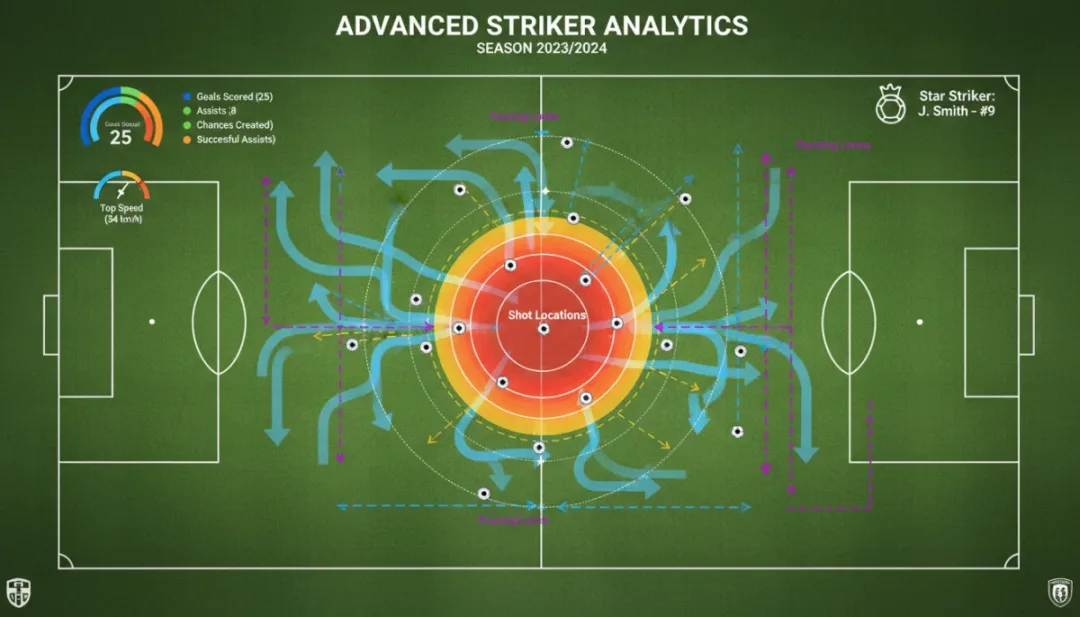
Progressive Carries, defined as a ball carry that moves the ball significantly closer to the opponent’s goal, are a key indicator of a striker’s ability to drive offensive transitions and break down defensive lines. This metric highlights players who are not just waiting for the ball in the box but actively contributing to advancing play and creating dangerous situations through their dribbling and movement.
In 2026, with the increasing emphasis on dynamic, fluid attacks, strikers capable of progressive carries are immensely valuable. They offer an additional dimension to their team’s offense, turning passive possession into active threats and disrupting opponent formations.
Disrupting Defenses and Creating Space
Strikers who excel in progressive carries possess excellent dribbling skills, spatial awareness, and the courage to take on defenders. Their ability to carry the ball into dangerous areas often draws defenders out of position, creating space for teammates or opening up shooting opportunities for themselves.
- Ball Progression: This metric directly measures a player’s contribution to moving the ball into attacking zones, essential for breaking down compact defenses.
- Dribbling Prowess: High progressive carries often correlate with exceptional dribbling skills and the ability to beat opponents one-on-one.
- Transition Play: Strikers adept at progressive carries are crucial in quick transitions, turning defense into attack with their direct running.
The impact of progressive carries extends beyond individual statistics; they fundamentally alter the dynamic of a game. A striker who can consistently drive the ball forward under pressure becomes a focal point for the attack, dictating the tempo and direction of offensive movements. This makes them a nightmare for opposing defenses to contain.
Therefore, progressive carries are a critical metric for assessing the modern striker’s value. It captures their active involvement in offensive build-up and their capacity to turn individual skill into tangible attacking momentum. For 2026, strikers who master this aspect will undoubtedly be among the most sought-after talents in Europe.
Integrating Metrics for a Holistic Player Profile
While each of the three metrics—Goals per 90, xG + xA, and Progressive Carries—offers valuable insights individually, their true power lies in their combined analysis. Integrating these data points allows for the creation of a holistic player profile, painting a comprehensive picture of a striker’s strengths, weaknesses, and overall impact on the pitch. This multi-faceted approach is essential for accurate valuation in a competitive market.
Clubs and analysts use these integrated profiles to identify players who not only score but also contribute significantly to chance creation and ball progression. This ensures that recruitment decisions are based on a deep understanding of a player’s all-around game, rather than relying on isolated statistics.
Building Comprehensive Player Reports
By combining these metrics, scouts and sporting directors can develop detailed reports that go far beyond what traditional scouting methods might reveal. Such reports can highlight players who are undervalued based on raw stats but excel in underlying metrics, or conversely, identify players whose high goal tallies might mask a lack of broader offensive contribution.
- Identifying Hidden Gems: Integrated data analysis can uncover talented strikers who might be performing well in less prominent leagues but show elite-level underlying numbers.
- Strategic Fit: Understanding how a striker performs across all three metrics helps determine their suitability for a specific tactical system or team philosophy.
- Development Pathways: These insights can also guide player development, identifying areas where a young striker needs to improve to maximize their potential value.
The synergy between these metrics allows for a nuanced understanding of a striker’s game. For instance, a player with a high G/90 and high xG+xA but low progressive carries might be a pure poacher, excelling in the box. Conversely, a striker with strong progressive carries and xG+xA but slightly lower G/90 might be a more complete forward who contributes significantly to build-up play and chance creation, even if not always the final scorer.
In conclusion, the integration of Goals per 90, xG + xA, and Progressive Carries is fundamental to building a truly comprehensive profile of a striker. This approach moves beyond surface-level observations, providing a data-driven framework for identifying, evaluating, and ultimately valuing Europe’s most impactful forwards for 2026.
Case Studies: Applying Metrics to Top European Strikers
To illustrate the practical application of these key performance metrics, let’s consider hypothetical examples of how they might define some of Europe’s top strikers for 2026. While specific player names are beyond the scope of this general analysis, we can outline archetypes that exemplify the value derived from these metrics.
Imagine a striker with an exceptionally high G/90, consistently converting chances at an elite level. This player might be a prime example of clinical finishing, a pure goal-scorer whose value is primarily tied to their ability to put the ball in the net. Their xG might be slightly lower than their actual goals, indicating exceptional finishing prowess.
Analyzing Diverse Striker Profiles
Then, consider another striker who boasts impressive xG and xA numbers, consistently creating high-quality chances for themselves and others, but perhaps with a slightly lower G/90. This player would be valued for their overall offensive threat, their ability to be at the heart of every attack, and their consistent chance creation. Their value lies in their foundational contribution to the team’s attacking output, even if they aren’t always the one scoring.
- The Clinical Finisher: High G/90, often outperforming xG. Value derived from consistent goal output.
- The Creative Forward: High xG + xA, strong progressive carries. Value in chance creation and offensive build-up.
- The All-Rounder: Balanced across all three metrics. Value in versatility, goal-scoring, and playmaking.
Finally, envision a striker who combines strong G/90 with excellent progressive carries and solid xG+xA. This player would represent the modern all-around forward, capable of scoring, creating, and driving the ball forward from deeper positions. Their comprehensive skill set would make them incredibly valuable, highly adaptable to various tactical systems, and a constant threat to opponents.
These archetypes demonstrate how the three metrics work in concert to highlight different facets of a striker’s game. By applying this data-driven lens, clubs can move beyond anecdotal observations to make informed decisions about player acquisition and development, ensuring they invest in talent that truly aligns with their strategic objectives for 2026.
The Future of Striker Evaluation: Beyond 2026
As football analytics continues to evolve, the methods for evaluating strikers will undoubtedly become even more sophisticated. Beyond 2026, we can anticipate the integration of new technologies and data sources that will provide an even deeper understanding of player performance. This ongoing evolution ensures that player valuation remains a dynamic and data-driven process.
Artificial intelligence and machine learning are already beginning to play a significant role in analyzing complex patterns of play, predicting player trajectories, and identifying subtle contributions that might be missed by traditional metrics. These advancements promise to further refine our ability to identify and value elite striker talent.
Emerging Technologies and Advanced Analytics
The use of GPS tracking, computer vision, and biometric data will likely become more prevalent, offering insights into a striker’s movement patterns, physical exertion, and decision-making under pressure. These richer datasets will allow for the creation of even more detailed and predictive player models.
- AI-Driven Scouting: Machine learning algorithms will assist in identifying potential transfer targets by analyzing vast amounts of player data.
- Biometric Performance Analysis: Understanding a player’s physical output and recovery rates will contribute to their overall valuation and injury prevention.
- Tactical Impact Metrics: New metrics will emerge to quantify a striker’s influence on team shape, pressing schemes, and defensive transitions.
The continuous development of analytical tools means that the definition of a ‘valuable striker’ will always be subject to refinement. What remains constant, however, is the commitment to data-driven decision-making. Clubs that embrace these advancements will maintain a competitive edge in the global transfer market, securing the best talent for their future success.
In conclusion, while Goals per 90, xG + xA, and Progressive Carries currently form the bedrock of striker valuation for 2026, the future promises even more innovative approaches. The continuous pursuit of deeper analytical insights will ensure that the identification of Europe’s most valuable strikers remains at the cutting edge of sports science and data. The journey of understanding player value is an ongoing one, constantly adapting to the evolving demands of the beautiful game.
| Key Metric | Brief Description |
|---|---|
| Goals per 90 (G/90) | Normalizes goal output by playing time, indicating consistent scoring threat. |
| Expected Goals (xG) + Expected Assists (xA) | Measures underlying chance creation and finishing quality, independent of actual outcomes. |
| Progressive Carries | Quantifies ball carries moving significantly closer to the opponent’s goal, indicating offensive drive. |
| Holistic Valuation | Combining these metrics provides a comprehensive view of a striker’s overall impact and market value. |
Frequently Asked Questions About Striker Valuation
Why are advanced metrics like xG and xA important for striker valuation?▼Advanced metrics like xG and xA are crucial because they measure the quality of chances created and taken, rather than just the outcome. This helps assess a striker’s underlying offensive contribution and consistency, providing a more stable evaluation than raw goal or assist totals alone.
How does “Goals per 90” differ from simply total goals scored?▼Goals per 90 (G/90) normalizes a striker’s goal output by the amount of time they spend on the pitch. This provides a fair comparison between players who might have different playing minutes, offering a more accurate representation of their scoring efficiency when actively involved in the game.
What do “Progressive Carries” reveal about a striker’s game?▼Progressive Carries highlight a striker’s ability to drive the ball forward into dangerous attacking areas. This metric indicates their skill in breaking down defenses, initiating offensive transitions, and creating space, showcasing their active contribution to building attacks beyond just finishing chances.
Can these metrics predict a striker’s future performance?▼Yes, these metrics, especially xG and xA, are considered strong predictors of future performance. By focusing on the quality of actions rather than just outcomes, they offer insights into a player’s sustainable contribution, making them valuable tools for forecasting potential and identifying consistent performers.
How do these metrics help in identifying undervalued strikers?▼By looking beyond raw goal counts, these metrics can reveal strikers who are performing exceptionally well in underlying aspects of the game but might be undervalued due to lower actual goal tallies. This data-driven approach helps clubs identify hidden gems whose contributions are not immediately obvious from traditional statistics.
Conclusion: The Data-Driven Quest for Europe’s Elite Strikers
The journey to identify Europe’s most valuable strikers for 2026 is no longer a subjective exercise based solely on highlight reels. It is a meticulous, data-driven quest, anchored by key performance metrics that offer profound insights into a player’s true worth. Goals per 90 remains the indispensable measure of scoring efficiency, while Expected Goals (xG) and Expected Assists (xA) peel back layers to reveal a striker’s underlying offensive threat and chance creation capabilities. Furthermore, Progressive Carries illuminate a forward’s capacity to actively drive attacks, disrupt defenses, and propel their team into dangerous positions. By integrating these three powerful metrics, clubs and analysts can construct comprehensive player profiles, moving beyond superficial observations to make informed decisions in a highly competitive market. As football continues its analytical evolution, these data points will remain crucial, ensuring that the identification of elite striker talent is as scientific as the beautiful game itself.