Data Analytics in Transfers: 2026 Scouting Metrics
Advertisements

By 2026, data analytics has become indispensable in football transfers, enabling scouting departments to move beyond traditional methods and utilize sophisticated metrics for identifying and acquiring optimal player targets.
The landscape of professional football is constantly evolving, and by 2026, data analytics football transfers have fundamentally reshaped how clubs identify and acquire talent. Scouting departments are no longer solely relying on traditional eye tests; instead, they are harnessing the power of advanced metrics to make more informed, strategic decisions in a highly competitive market. This shift promises to bring unprecedented precision to player recruitment.
The Evolution of Scouting: From Eyeball to Algorithm
For decades, football scouting was an art form, relying heavily on the subjective judgment of experienced observers. Scouts would travel the globe, watching countless matches, and compiling reports based on their intuition and understanding of the game. While invaluable, this approach had inherent limitations, often missing hidden gems or overvaluing players based on limited exposure.
The advent of data analytics has ushered in a new era, transforming scouting into a science. Clubs now employ teams of data scientists and analysts who work alongside traditional scouts, integrating quantitative insights with qualitative observations. This blended approach provides a more comprehensive and objective view of a player’s potential and fit within a team’s tactical framework.
Early Adopters and Their Impact
Some clubs were quicker to embrace data-driven scouting, gaining a significant edge in the transfer market. These pioneers demonstrated that metrics could unearth talents overlooked by competitors, leading to more efficient spending and improved on-field performance.
- Reduced Transfer Risk: Data provides a clearer picture of a player’s consistency and adaptability.
- Identification of Undervalued Talent: Metrics can highlight players performing exceptionally in less-watched leagues.
- Strategic Squad Building: Analytics help identify specific player profiles needed to fill tactical gaps.
The evolution from purely subjective assessments to a hybrid model has proven critical. It allows clubs to not only confirm what scouts see but also challenge preconceptions and discover patterns that human observation might miss, ensuring a more robust and future-proof recruitment strategy.
Key Performance Indicators (KPIs) Beyond the Obvious
In 2026, scouting departments are using a far more sophisticated set of Key Performance Indicators (KPIs) than ever before. Moving beyond simple goals and assists, these metrics delve deep into a player’s contribution, providing a granular understanding of their strengths and weaknesses. This detailed analysis allows for a more precise evaluation of a player’s suitability for a particular role or system.
Expected Goals (xG) and Expected Assists (xA) have become standard, offering insights into a player’s genuine attacking threat beyond the final outcome. However, the current generation of analytics goes much further, examining contextual data that paints a richer picture of performance.
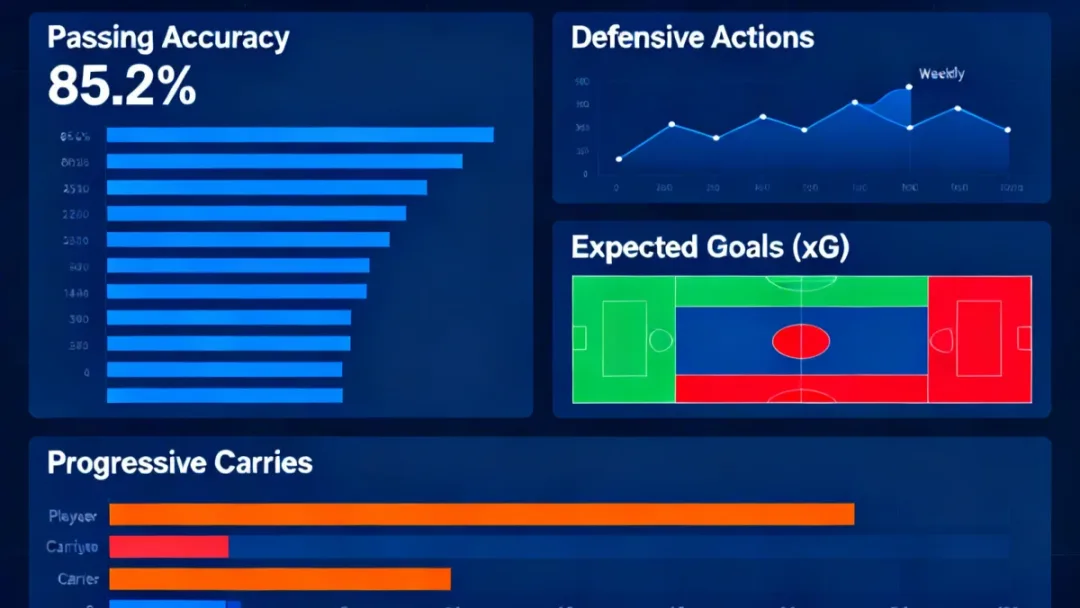
Metrics like ‘progressive carries’ measure a player’s ability to move the ball upfield effectively, while ‘successful pressures’ quantify defensive contributions in high-pressing systems. These are not just raw numbers but are often weighted by opposition strength, game state, and pitch location, providing a highly nuanced view.
Advanced Defensive Metrics
Defensive analytics have also seen significant advancements. Beyond tackles and interceptions, metrics now assess:
- Defensive Duel Success Rate: How often a player wins one-on-one defensive battles.
- Ball Recoveries in Dangerous Areas: Quantifying a player’s ability to regain possession high up the pitch.
- Pressure Regains: Measuring how quickly and effectively a player contributes to winning the ball back after a press.
These advanced KPIs enable clubs to identify players who excel in specific tactical roles, whether it’s a ball-playing center-back capable of breaking lines or a high-energy midfielder who can disrupt opposition attacks effectively. The focus is no longer just on what a player does, but how and why they do it, and the impact it has on team success.
Predictive Modeling: Forecasting Future Performance and Injury Risk
One of the most revolutionary aspects of data analytics in 2026 is the rise of predictive modeling. Scouting departments are no longer just looking at past performance; they are using complex algorithms to forecast how a player might perform in the future, how they might adapt to a new league, and crucially, their potential for injury. This foresight significantly de-risks transfer investments.
These models integrate a vast array of data points, including physical characteristics, playing style, historical injury records, and even psychological profiles. Machine learning algorithms identify patterns that correlate with future success or failure, providing clubs with probabilities rather than just possibilities. For example, a model might predict a young player’s peak performance age or their likely development trajectory.
Injury Prediction and Mitigation
Player health is paramount, and predictive analytics are proving vital in mitigating injury risks. Clubs can now:
- Identify High-Risk Players: Algorithms flag players with historical patterns suggesting susceptibility to certain injuries.
- Personalized Training Regimens: Data helps tailor training loads to prevent overexertion and reduce injury likelihood.
- Long-Term Career Planning: Understanding a player’s physical resilience aids in planning their career longevity.
By leveraging predictive modeling, clubs can make more informed decisions about which players to target, not just based on their current ability, but on a well-researched projection of their future value and availability. This proactive approach ensures that investments are made in players who are more likely to deliver sustained performance.
The Role of AI and Machine Learning in Talent Identification
Artificial Intelligence (AI) and Machine Learning (ML) are at the forefront of talent identification in 2026. These technologies sift through colossal datasets, identifying patterns and correlations that would be impossible for human analysts to detect. AI-powered systems can watch thousands of hours of footage, tagging and categorizing every action, providing an unparalleled level of detail.
ML algorithms are trained on historical data of successful transfers and player development, learning what attributes and circumstances lead to a player reaching their full potential. This allows them to generate lists of potential targets that align perfectly with a club’s specific needs, tactical philosophy, and budget constraints. The days of simply watching highlight reels are long gone; AI now provides a granular, objective assessment of a player’s suitability.
Automated Player Comparison
AI tools can instantly compare a potential target to existing players in a squad or to successful players in similar roles across top leagues. This comparison goes beyond surface-level stats, looking at:
- Stylistic Fit: How well a player’s actions align with a team’s preferred playing style (e.g., possession-based, counter-attacking).
- Tactical Versatility: A player’s ability to perform effectively in multiple positions or tactical setups.
- Market Value Prediction: AI models can estimate a player’s fair market value, preventing overspending.
The integration of AI and ML means scouting departments can process more information, identify more relevant targets, and make faster, more data-backed decisions. This technological leap ensures that clubs remain competitive in a rapidly evolving transfer market, consistently pinpointing players who offer the best return on investment.
Integrating Data with Human Expertise: The Hybrid Approach
While data analytics and AI provide immense quantitative power, they do not replace the irreplaceable value of human expertise. In 2026, the most successful scouting departments operate on a hybrid model, where data insights complement, rather than supersede, the nuanced understanding of experienced scouts and coaches. This synergy ensures a holistic evaluation of potential targets.
Human scouts bring contextual understanding, assessing aspects that data struggles to quantify: a player’s leadership qualities, work ethic, personality, adaptability to different cultures, and mental resilience under pressure. These ‘soft skills’ are often the deciding factors in whether a talented player truly succeeds at a new club.
The Collaborative Workflow
The ideal workflow involves:
- Data-Driven Shortlisting: Analytics generates a preliminary list of players matching specific criteria.
- Human Validation and Observation: Scouts then physically observe these players, assessing their character and intangible qualities.
- Joint Decision-Making: Data analysts, scouts, and coaching staff collaborate to make final recommendations.
This integrated approach ensures that decisions are robust, combining the objective prowess of data with the subjective wisdom of human judgment. It prevents clubs from signing players who look good on paper but lack the personality or mental fortitude to thrive, or conversely, overlooking players whose unique traits might not be immediately apparent in statistical models.
Challenges and the Future of Data-Driven Transfers
Despite its undeniable benefits, the widespread adoption of data analytics in football transfers is not without its challenges. Data quality, the ethical use of player information, and the potential for ‘data overload’ are significant considerations that clubs must navigate. Ensuring that data is accurate, relevant, and interpreted correctly is paramount to avoid flawed conclusions.
Another challenge lies in establishing a common language and understanding between data scientists and traditional football personnel. Bridging this gap requires ongoing education and a culture of collaboration within scouting departments. The goal is to empower, not overwhelm, decision-makers with insights.
Evolving Data Sources and Privacy
- Wearable Technology: Increasingly sophisticated wearables provide real-time physiological data.
- Biometric Data: Analysis of genetic predispositions and recovery rates.
- Ethical Considerations: Balancing data utilization with player privacy and well-being.
Looking ahead, the future of data-driven transfers will likely involve even more personalized player development plans, deeper integration of psychological data, and potentially, AI-driven negotiation strategies. As data becomes more ubiquitous and sophisticated, the competitive advantage will shift from simply having data to effectively interpreting and acting upon it. Clubs that master this will continue to dominate the transfer market, shaping the future of football by identifying and securing the next generation of global stars with unparalleled precision.
| Key Aspect | Description |
|---|---|
| Hybrid Scouting | Combines traditional human scouting with advanced data analytics for comprehensive player evaluation. |
| Advanced KPIs | Goes beyond basic stats to include contextual metrics like progressive carries and defensive duel success. |
| Predictive Modeling | Uses algorithms to forecast future performance, injury risk, and player development. |
| AI Integration | AI and Machine Learning analyze vast datasets for talent identification and player comparison. |
Frequently Asked Questions About Data Analytics in Football Transfers
How has data analytics changed traditional scouting methods?▼Data analytics has transformed traditional scouting by complementing subjective ‘eye tests’ with objective metrics. It provides deeper insights into player performance, consistency, and potential, allowing scouts to identify undervalued talent and make more informed decisions, enhancing the efficiency and accuracy of recruitment processes.
What are some key metrics used in 2026 for player evaluation?▼Beyond traditional goals and assists, 2026 scouting utilizes advanced metrics like Expected Goals (xG), Expected Assists (xA), progressive carries, defensive duel success rate, and pressure regains. These contextual KPIs offer a granular understanding of a player’s contribution and fit within specific tactical systems, revealing their true impact.
Can data analytics predict a player’s future performance or injury?▼Yes, predictive modeling, powered by machine learning, is now a crucial tool. It integrates historical data, physical attributes, and playing styles to forecast future performance, adaptation to new leagues, and potential injury risks. This helps clubs make strategic investments in players likely to maintain high performance levels and availability.
Do AI and machine learning replace human scouts entirely?▼No, AI and machine learning do not replace human scouts but rather augment their capabilities. While AI identifies patterns in vast datasets and automates comparisons, human scouts provide crucial contextual understanding, assessing intangibles like character, work ethic, and mental resilience, which data alone cannot fully capture.
What are the main challenges in using data analytics for transfers?▼Key challenges include ensuring data quality and accuracy, avoiding ‘data overload,’ and bridging the communication gap between data scientists and football staff. Ethical considerations regarding player data privacy and the need for continuous education on data interpretation also remain significant hurdles for clubs.
Conclusion
The integration of data analytics into football transfers by 2026 has irrevocably altered the landscape of player recruitment. What began as a supplementary tool has evolved into a foundational pillar, enabling scouting departments to identify talent with unprecedented precision and foresight. The hybrid approach, blending advanced metrics with invaluable human intuition, stands as the gold standard, ensuring that clubs make not just data-driven decisions, but truly informed ones. As the technology continues to advance, the competitive edge will belong to those who can master the interpretation and application of these sophisticated insights, securing the future stars of the beautiful game.